

For a long time I logged all my climbs on theCrag or 8a.nu. But I always felt something was missing for me: notes, a way to track a project, a way to see every session on a route in one place, and photos and videos that only I see. That's the direction I took when I built my own app, and it's where I log everything now.
This is what I track for outdoor climbs, and what I do with it afterwards.
In short
- For every outdoor climb: send or attempt, how I sent it, grade, date, and where.
- For routes from 6b up: terrain and hold type, so I can see my gaps.
- When it matters: notes (skin, sleep, tiredness) and which goal it counts toward.
- Then I use it to track my progress: tries per grade, my grade pyramid, and the performance pillars.
What I log for every climb
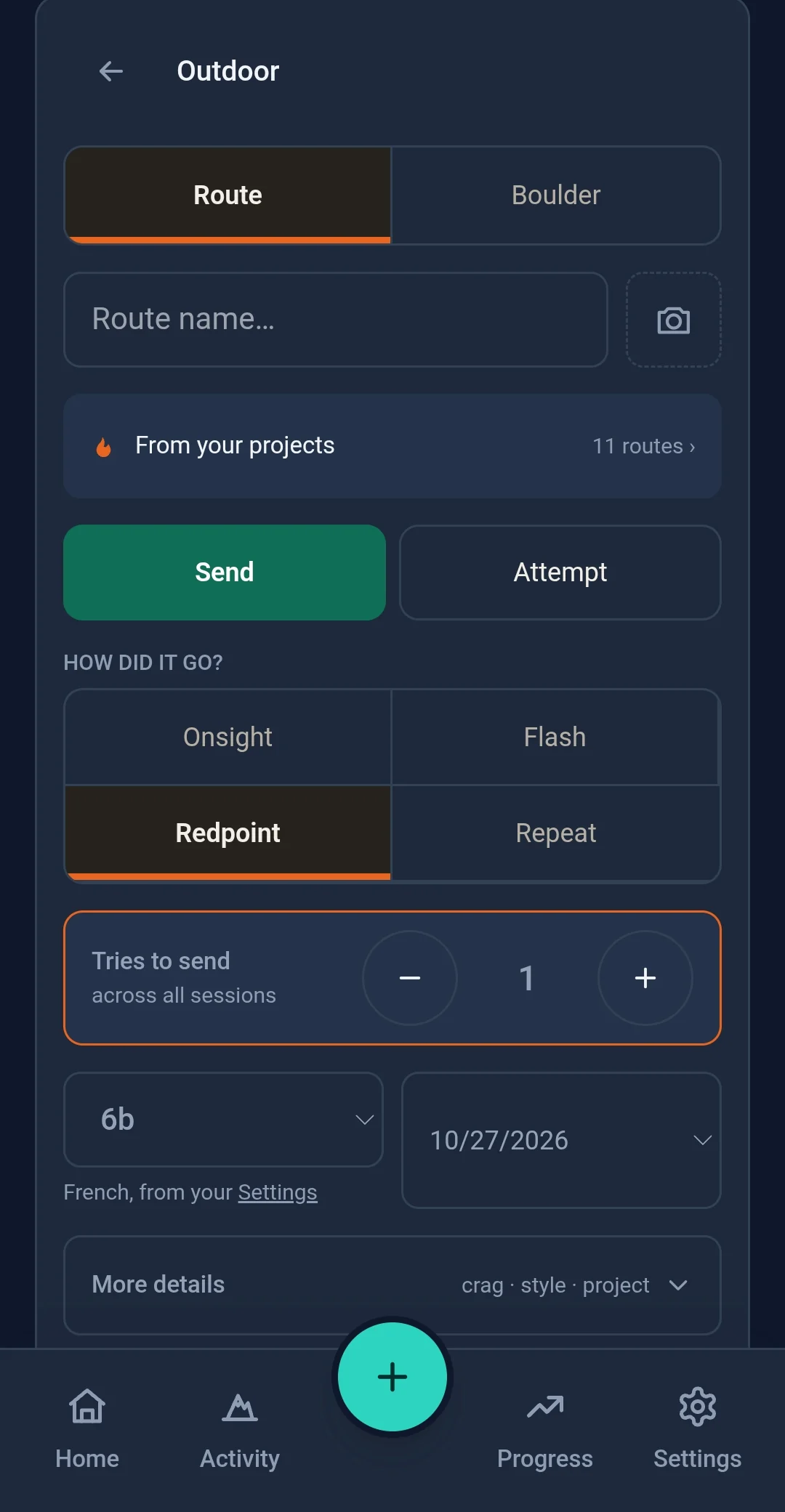
When I tap the plus sign for an outdoor climb, I start with the route name. I can add a photo too, but for outdoor climbs I usually don't. Media goes into my projects instead: if I've solved the beta on a project, I add a video of it so I can see the move again whenever I want.
Send or attempt. I always log this. If it's an attempt, it automatically becomes a project. So if I don't send a route, it goes straight into my projects, and every time I go back to it, it's all there. When I finally send it, the project is marked complete and moves to my trophy shelf.
How I sent it. When it's a send, I always pick onsight, flash, redpoint, or repeat. There are a few routes at my local crag that I've done seven to ten times. I use them as warm-ups, then go and give my project a try.
Grade and date. Of course.
Where. I like having all the details: location, crag, sector, country.
Terrain and hold type. This one is optional, and I only fill it in for routes from 6b up, a few grades under my max. I think it matters to see what I've climbed most and where my gaps are. For example, I haven't climbed many roofs or overhangs on jugs.
Notes. Sometimes I write that it didn't go great because my skin wasn't in good shape, or I was really tired, or I didn't sleep the night before.
Goals. I have a few goals. One of them is to send six 6c+ routes. When I send one, I tick Count toward a goal, pick the goal from the list, and it counts toward the target.
I also like that everything from the same day lands in one session. If I add another climb, it joins the same session, and at the end I save the whole session. So all my climbs from one day stay grouped together.
How I use it to track my progress
Tries per grade
On the home page I can see my overall outdoor sends, and I like to look at tries. For 7a, it takes me 4.5 tries on average to send. For 6b it's 1.3, so I'm mostly flashing those. That's probably one of my strongest grades, which doesn't mean I'll send every 6b. But it shows me where my biggest gap is, and what to try and work on more.
My grade pyramid
This is one of my favorites. It shows me the balance between the grades I climb.
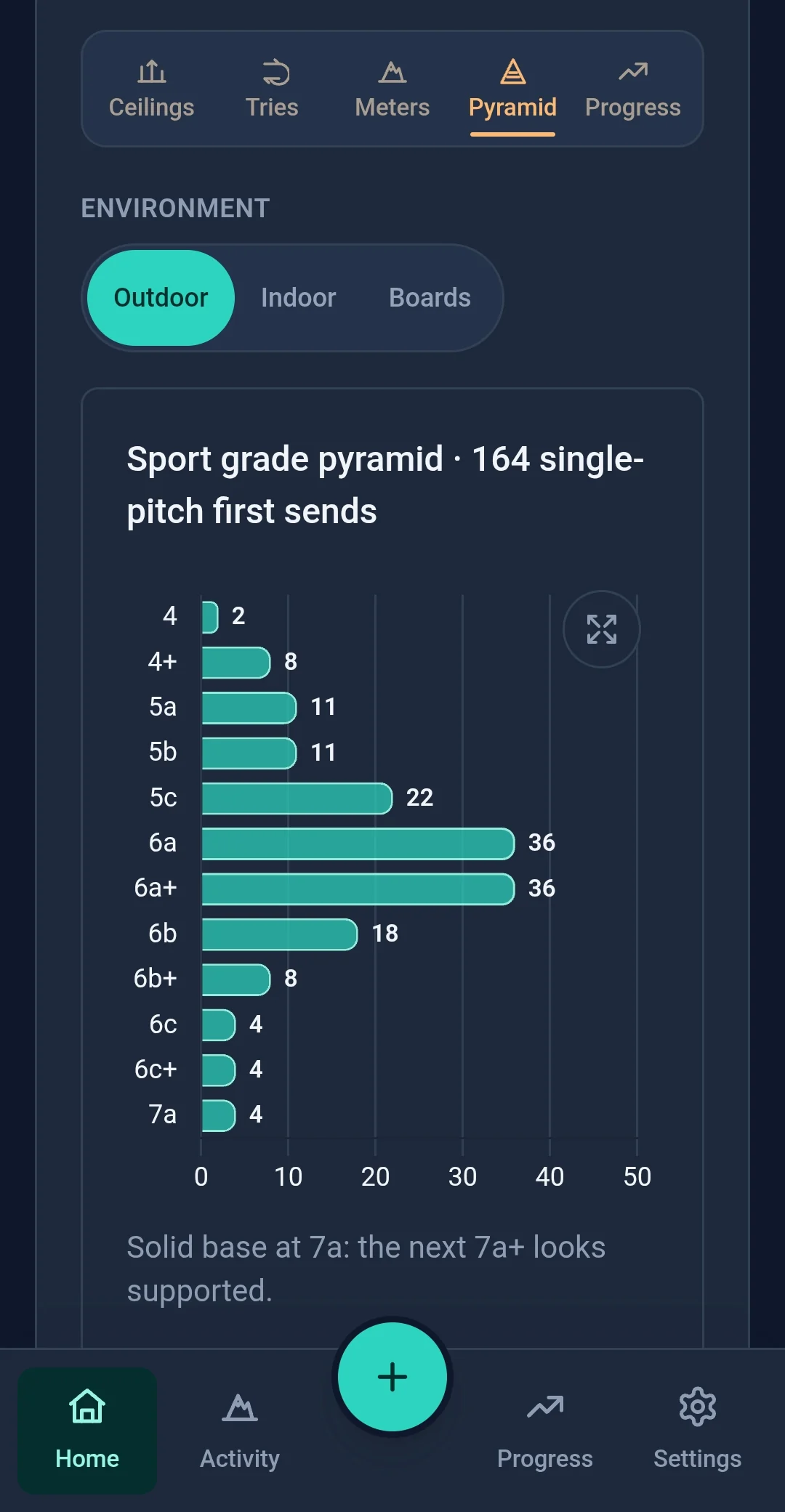
My outdoor pyramid right now. The app's read underneath: "Solid base at 7a: the next 7a+ looks supported."
In the beginning I was really scared to move up to the next grade, and I can see that pattern starting again. Right now I have four 6c, four 6c+, four 7a, and no 7a+. I've tried a few 7a+ routes and they feel very doable. I just haven't worked them yet.
So I need to push myself a little into the next grade, but I also want to make the base from 6c to 7a more solid: at least nine 6c and at least six 6c+, with the 7a count growing from four. I want that base to be stable, and to add volume where I have gaps.
Performance
After I've logged my climbs, I check Progress, then Performance. Today it says I could flash around 6c+ and project around 7b, and it's pretty clearly nudging me toward 7a+ outdoors.
It also shows five pillars: strength, power, power-endurance, endurance and technique. They all feed from what I track, and that includes workouts. Today I did an endurance session on the auto belay: up and down for 12 to 15 minutes, three rounds. I logged it, and my endurance pillar will move up. It won't grow forever, though. It also keeps count of my top sends and other things.
Technique for me today sits around a 6c+ flash, because that's roughly where I flash, in the gym and outside. The evidence behind it is 28 clean sends near my limit in the last 26 weeks, across 9 different styles. It's a practice band, not a score and not the grade I send: it shows how much I'm climbing near my limit across different styles, which is the practice that builds technique. That's why I tag terrain and hold type for both indoor and outdoor climbs, mostly when a route is interesting or a higher grade.
Strength is the one I've been lacking. For that there's a strength benchmark test in the app. You schedule it as a training session, follow the steps, and add your results in the benchmarks section. It covers weighted pull-ups and hangs, with and without weight: the things that show you where you are in strength, and in the other pillars that help you perform and move up to the next level.
What I'm working on next
That's how I check what I'm lacking most. Right now, for example, I haven't trained power-endurance in a while, and I know that's the pillar I need to work on the most.
Everything in one place
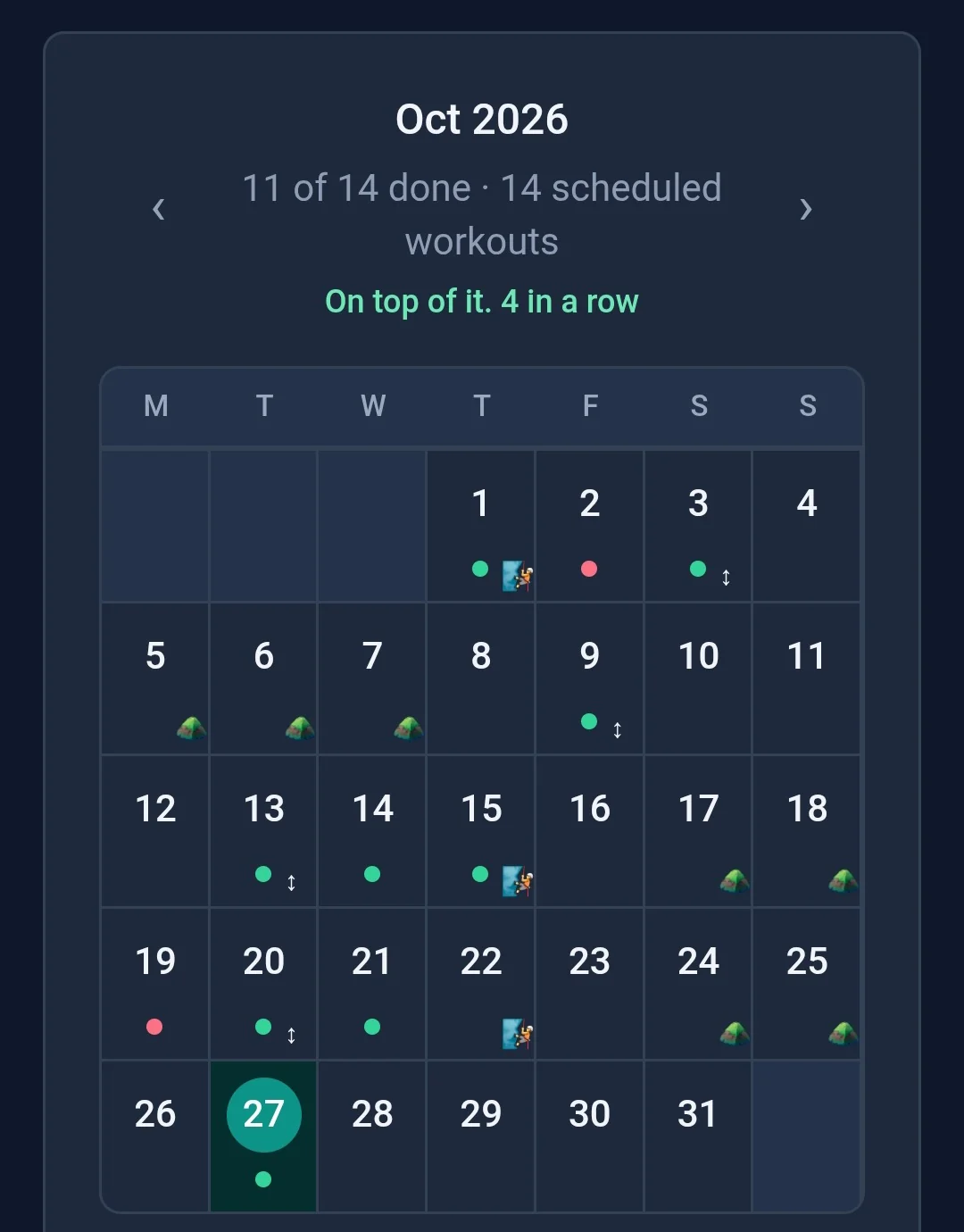
I also like that all my climbs show up in the climbing calendar on the training page, so I can see exactly when I climbed. And I wanted to tie all of it in with the training I do off the wall, not just on it.
That's really why I built it. I wanted everything related to my climbing in one place: how I train, how I climb, my routes, but also what my performance shows, what my goals are, and how they all tie together.
If you want to log the same way, try it now.
Rox